
Home
Architecture
Art
Beauty/Health
Beer
Business/Economy
Cars
Celebrities
Christmas
Dictionaries
Education
Fashion/Clothes
Food
Galleries
Gays/Lesbians
Genealogy
German Names
Germans Abroad
History
Holidays
Homework Help
Learn German
Law
Literature
Loveparade
Movies
Music
Nazi
News
Oktoberfest
Philosophy
Today in History
Traditions
Travel to Germany
Wines
More topics...
Facts About Germany
Armed Forces
Education
Economy
History
Geography
Mass Media
Politics
Society
German History
Early History
Medieval History
Thirty Years' War
Weimar Republic
Third Reich
Postwar
Honecker Era
Berlin Wall
Bismarck
German Recipes
Salads
Main Dishes
Desserts
Baking
German Chocolate Cake
Easter Dishes
Halloween Dishes
Christmas Dishes
How To in Germany
Articles
Quizzes
|
World War II - Defeat
In June 1944, American, British, and Canadian forces invaded France,
driving the Germans back and liberating Paris by August. A German counteroffensive
in the Ardennes began in late December was beaten back after heavy fighting
in what became known as the Battle of the Bulge. Soviet troops, meanwhile,
advanced from the east. Western forces reached the Rhine River in March
1945; simultaneously, Soviet armies overran most of Czechoslovakia and
pressed on toward Berlin. Although faced with certain defeat, Hitler insisted
that every German city, every village, and "every square meter" be defended
or left behind as "scorched earth." The Western Allies and the Soviet
forces made their first contact, in Saxony, on April 27. Three days later,
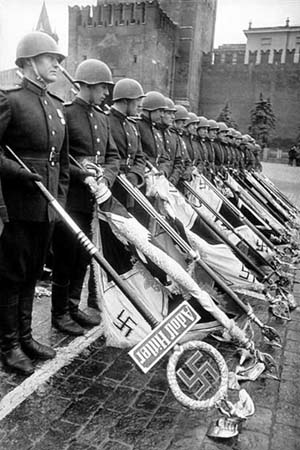
Hitler committed suicide in a Berlin bunker. Berlin fell to the Soviet
forces on May 2; on May 7, the Third Reich surrendered unconditionally.
It is estimated that about 55 million people died in the European theater
during World War II. About 8 million of these dead were German.
* * *
A good introduction to German history is Mary Fulbrook's A Concise
History of Germany, which not only presents the most important events
but also examines various interpretations of them. The book closes with
a bibliography of recent scholarship. Geoffrey Barraclough's The Origins
of Modern Germany is a classic study of the German Middle Ages. Early
Modern Germany, 1477-1806 by Michael Hughes is a good introduction
to this period. C.V. Wedgwood's classic, The Thirty Years' War,
is engrossing reading and is widely available. A more recent treatment
of the war is found in The Thirty Years' War, a well-integrated
collection of articles about the conflict by noted specialists edited
by Geoffrey Parker.
James J. Sheehan's subtle and learned German History, 1770-1866
is the standard work in English on the period. Theodore S. Hamerow's Restoration,
Revolution, Reaction, concise and beautifully written, deals with
the main political, economic, and social trends between 1815 and 1871.
Gordon A. Craig's Germany, 1866-1945, a survey of these years
by the English-speaking world's dean of German studies, can be found in
many libraries. Volker Rolf Berghahn's Imperial Germany, 1871-1914
provides a sophisticated analysis of Germany between unification and the
outbreak of World War I. James Joll's brief The Origins of the First
World War examines interpretations of why this war occurred. The
German Dictatorship by Karl Dietrich Bracher is an excellent treatment
of the ideological sources of national socialism and provides an analytical
history of Hitler's regime. Donald Cameron Watt's magisterial How
War Came examines the diplomatic maneuvering leading up to World
War II. Gerhard L. Weinberg's A World at Arms is an authoritative
and comprehensive survey of the war.
- The Third Reich, 1933-1945:
Consolidation of Power
- Foreign Policy
- The Outbreak of World
War II
- Total Mobilization, Resistance,
and the Holocaust
- Defeat
|
|